
House Of Nyayenga Peace
A collection of stories rooted in ordinary life written for every diaspora soul.
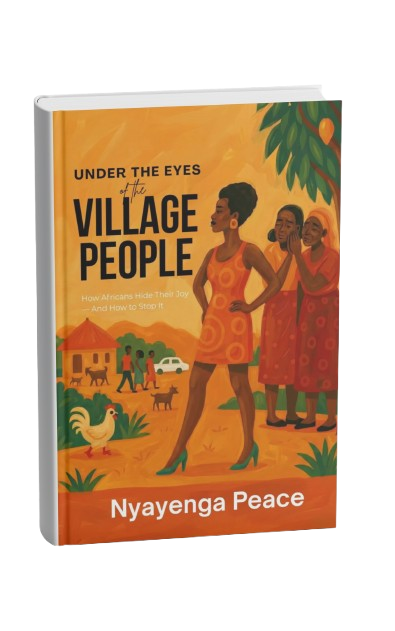
Under the eyes of the village People
In Africa, success is never personal , it’s a public event managed by ancestors, aunties, and at least three prophets with airtime.Through Akello Nam’s eyes, Nyayenga Peace takes us from Kampala to Nebbi to Copenhagen, where tradition meets Wi-Fi, superstitions go digital, and every blessing comes with a spiritual disclaimer. Weddings without faces. Pregnancies hidden like government tenders. Progress that must first pass through the comment section. Village People is a bold, hilarious, and painfully honest portrait of modern African life, peeling back the laughter to reveal something deeper: the quiet fear of being seen, the inherited caution we call respect, and the invisible tug-of-war between culture and freedom.Told with humour, heart, and an unforgettable voice, this book will make you laugh, reflect, and whisper, “Eh, this is so true.”Because sometimes the real enemy isn’t witchcraft or jealousy. It’s the fear of your own light.
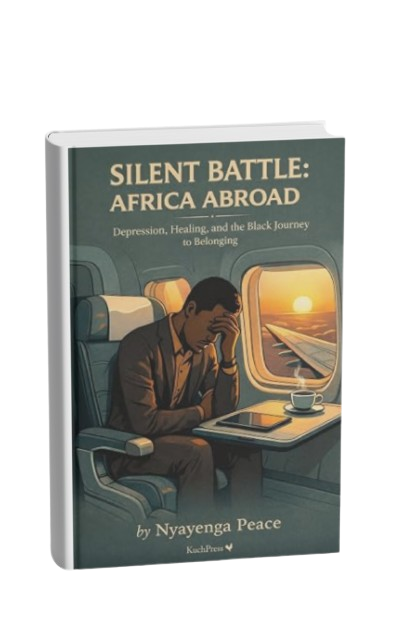
Silent Battle : Africa Abroad
In some African families and communities, conversations about mental health are still surroundedbysilence.Depression is sometimes misunderstood, dismissed as weakness, or explained only through spiritual language. But what happens when someone is quietly struggling while trying to survive life abroad In Silent Battle: Africa Abroad, Nyayenga Peace explores the emotional struggles that some Africans experience while living in the diaspora — including loneliness, pressure, cultural expectations, and the difficulty of speaking openly about mental health. Drawing from observation, lived experience, and conversations within migrant communities, the book gently opens a conversation about depression, stigma, and the importance of seeking help. Written in clear and accessible language, this book explains what depression can look like, why it is often misunderstood, and how healing may involve many forms of support including therapy, community, faith, movement, and honest conversation. Silent Battle: Africa Abroad is an invitation to break silence, replace shame with understanding, and create space for healthier conversations about emotional well-being. In some African families and communities, conversations about mental health are still surrounded by silence. Depression is sometimes misunderstood, dismissed as weakness, or explained only through spiritual language. But what happens when someone is quietly struggling while trying to survive life abroad? In Silent Battle: Africa Abroad, Nyayenga Peace explores the emotional struggles that some Africans experience while living in the diaspora — including loneliness, pressure, cultural expectations, and the difficulty of speaking openly about mental health. Drawing from observation, lived experience, and conversations within migrant communities, the book gently opens a conversation about depression, stigma, and the importance of seeking help.Written in clear and accessible language, this book explains what depression can look like, why it is often misunderstood, and how healing may involve many forms of support including therapy, community, faith, movement, and honest conversation. Silent Battle: Africa Abroad is an invitation to break silence, replace shame with understanding, and create space for healthier conversations about emotional well-being.
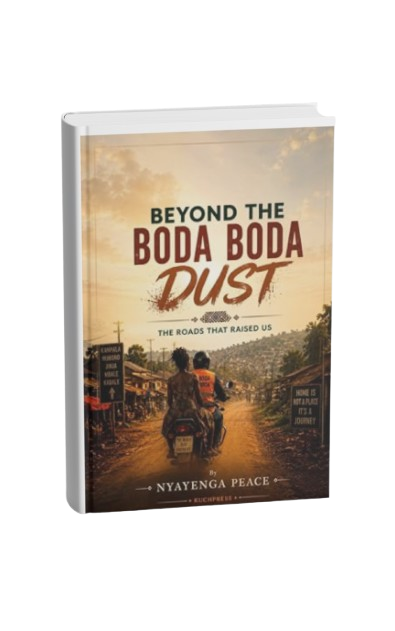
Beyond the Boda Boda Dust
Beyond the Boda Boda Dust is a powerful coming-of-age novel about grief, survival, family, migration, and the roads that shape ordinary lives. After a devastating accident takes her father, twelve-year-old Amina is forced to grow up faster than childhood allows. As relatives circle, poverty tightens, and the family begins to fracture under the weight of loss, she learns that survival is not always loud. Sometimes it is carried quietly through sacrifice, responsibility, and the stubborn refusal to let the people you love disappear. Set between the dusty roads of Uganda and the complicated promises of life abroad, this deeply human and cinematic story explores what happens when grief arrives too early and childhood is interrupted by survival. A tender and emotionally layered novel about resilience, belonging, loss, and the invisible work of becoming.
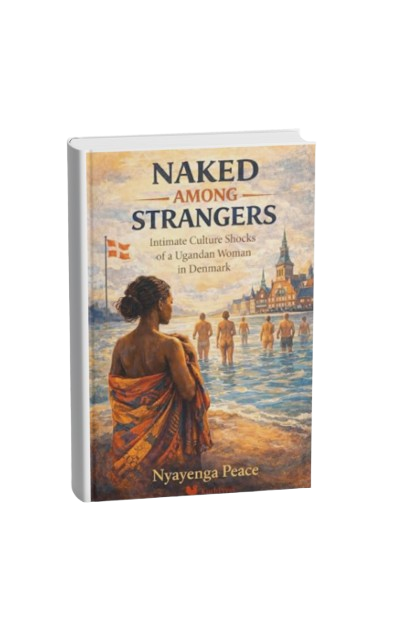
Naked Among Strangers
A Ugandan woman walks into a Danish swimming hall expecting water, towels, and an ordinary day Instead, she walks into one of the quietest forms of culture shock she has ever experienced. In Naked Among Strangers, Nyayenga Peace explores the intimate, often unspoken ways migration reshapes the body, identity, modesty, motherhood, beauty, race, belonging, and everyday life. Through vivid storytelling, humour, vulnerability, and sharp social observation, she reflects on what it means to move through public showers, saunas, hospitals, changing rooms, parenting, hair culture, relationships, and European life as a Black African woman living in Denmark. This is not a book about dramatic headlines or political speeches. It is a book about smaller moments: Standing under harsh white lights in a changing room.
Learning how to look away respectfully in public nudity spaces. Managing Black hair before swimming lessons.
Hearing immigrants discussed casually in a sauna while sitting silently among strangers. Watching children adapt to a world that once shocked their mother. Warm, cinematic, reflective, and deeply human, Naked Among Strangers explores the emotional realities of living between cultures and the invisible negotiations many migrants carry quietly inside the body. For readers interested in migration, diaspora life, motherhood, race, identity, belonging, intercultural living, and narrative nonfiction that feels both personal and universal, this book offers an honest and unforgettable journey through the spaces where culture becomes physical.
The Jar Has Spoken
What happens when a jar refuses to open and society turns it into a lecture about womanhood, marriage, and “needing a man”? In The Jar Has Spoken, Nyayenga Peace turns everyday frustrations into sharp, funny,andpainfullyrecognizable social commentary. A stubborn mayonnaise lid. A wobbling chair. IKEA instructions with bad intentions. A green wall ruining summer pictures. Teenage negotiations. Winter tires. WiFi drama. Household moments that should have remained small suddenly become evidence in the court of public opinion. With humor, insight, and emotional honesty, this satirical collection explores how some social spaces use ordinary inconvenience to question women’s independence, dignity, and life choices. Beneath the laughter is a deeper truth about pressure, gender expectations, motherhood, migration, and the exhausting habit of turning practical problems into moral judgments. Set between Uganda and Denmark, this book is witty, observant, and deeply human. It is for readers who enjoy smart social commentary, relatable domestic comedy, and books that can make them laugh while also making them feel seen. The Jar Has Spoken is not a book about jars. It is a book about what people do with women’s lives when they are given even the smallest excuse.

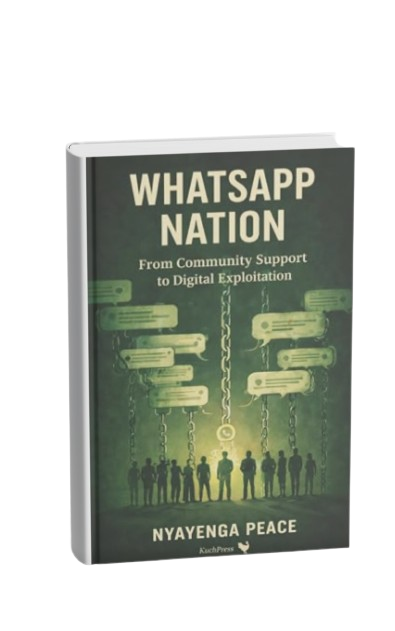
WhatsApp Nation
In many African communities and across the diaspora, WhatsApp began as a digital village square. It was where people checked in, raised support, shared urgent news, celebrated milestones, mourned losses, and stayed connected across borders. It felt like community in the palm of the hand. But somewhere along the way, that same space began to change. In WhatsApp Nation: From Community Support to Digital Exploitation, Nyayenga Peace explores how a tool once rooted in connection can slowly become a source of pressure, performance, manipulation, financial exhaustion, emotional fatigue, gossip, entitlement, and silent resentment. With honesty, cultural insight, and lived reflection, this book examines the unspoken dynamics inside group chats, family groups, diaspora networks, fundraising culture, social obligation, and digital visibility. It asks difficult but necessary questions: When does support become control? When does community become surveillance? When does staying connected start costing us our peace? This is not a book that attacks community. It is a book that invites us to think more deeply about the digital habits we have normalized, the emotional burden we carry in online spaces, and the boundaries we may need in order to protect our mental and financial well-being. Thought-provoking, sharp, and deeply relevant, WhatsApp Nation is for readers who have ever felt drained by the very spaces that were supposed to make them feel supported.
The Philosophy Behind The House Of Nyayenga Peace
At the House of Nyayenga Peace, I don’t write to tell people what to think. I write to create a space where people feel safe enough to think.
Safe enough to ask difficult questions.
Safe enough to laugh at themselves.
Safe enough to challenge old beliefs.
Safe enough to learn about lives different from their own.
Safe enough to recognize themselves in someone else’s story.
My books are written like conversations with a trusted friend, not lectures from an expert. They are places where culture, migration, mental health, family, grief, love, faith, identity, and everyday life can be explored with curiosity, compassion, and honesty.
I hope my stories become safe spaces, conversation starters, and bridges between people. If a reader closes one of my books feeling seen, feeling understood, learning something new, or simply wanting to continue the conversation, then the book has done exactly what it was meant to do.
Because stories don’t just entertain us. They help us recognize ourselves, understand one another, and imagine a kinder world together.
Why I Write Through an Afrocentric Lens
People sometimes ask me why so many of my stories are rooted in Africa. My answer is simple. Because Africa is home. It is where I first learned what family means. It is where I first experienced community. It is where I learned to laugh, to grieve, to hope, and to dream. It is where my understanding of people began. Even though I now live in Denmark, I didn’t stop being Ugandan the day I boarded a plane. My roots travelled with me. My memories travelled with me. My way of seeing the world travelled with me. That is why my writing is Afrocentric. “Not because I believe African stories are the only stories worth telling. But because they are the stories that first taught me what it means to be human.” I often say that I don’t write to explain Africa to the world. I write from Africa’s perspective while exploring experiences that connect us all. That difference matters. Africa is not simply the subject of my books. It is the lens through which I see the world. Every writer has a lens. Some write through the experiences of the places that raised them. Others through the cultures that shaped them. I write through an Afrocentric lens because that is where my journey began. But the stories themselves belong to everyone.
So while many of my stories begin in Uganda or are inspired by African experiences, they are never only about Africa. They are about people. About what connects us. About the ways we love, misunderstand one another, raise children, build communities, carry grief, search for belonging, and make sense of the lives we’ve been given. “I write about universal human experiences through an Afrocentric lens. Because that is the most honest way I know how to tell a story.” And I believe that the more honestly we tell our own stories, the more deeply they resonate with people everywhere.
